







Experimental Particle and Astroparticle Physics
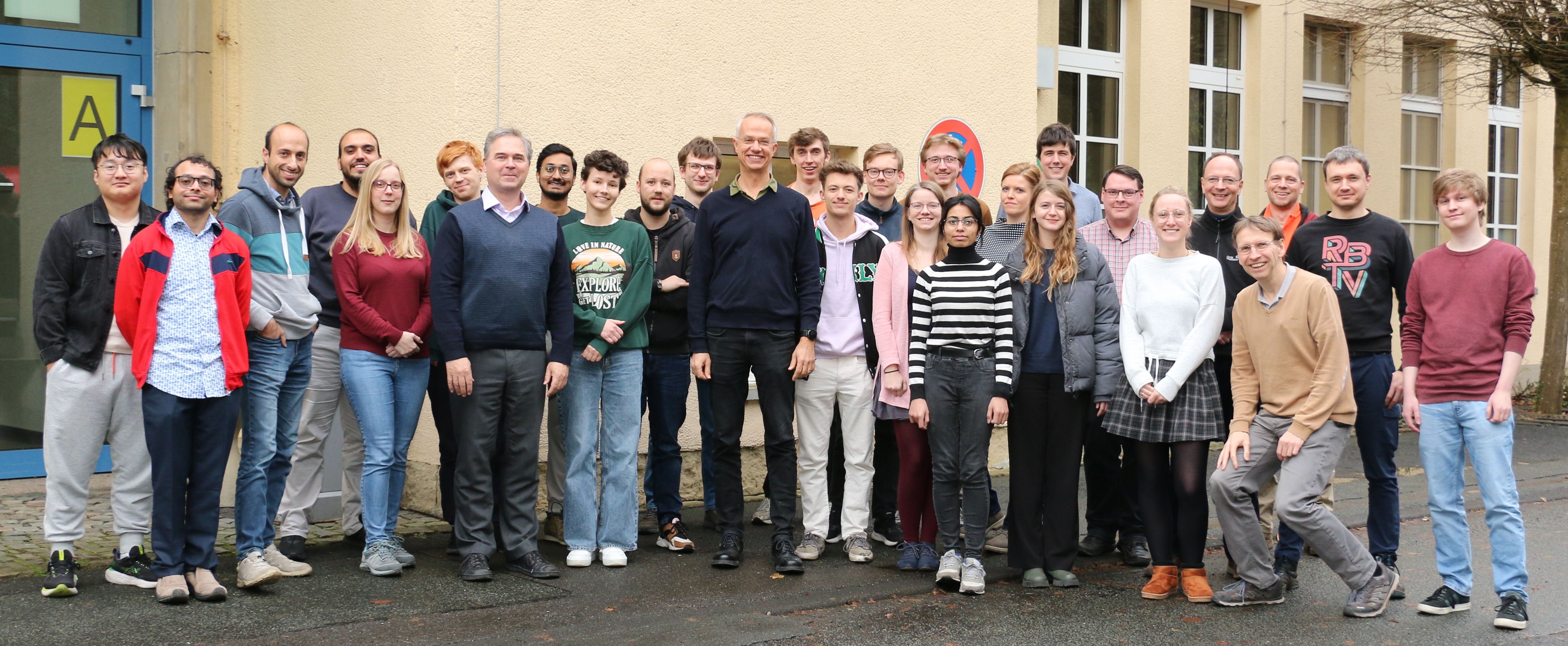
Welcome to the Experimental Particle and Astroparticle Physics Group at the University of Siegen!
Our research addresses some of the most fundamental questions in modern physics: What are the elementary building blocks of matter? How do they interact? What lies beyond the Standard Model of particle physics? What is the origin of dark matter, and what can we learn about the Universe from cosmic rays and gravitational waves?
We investigate these questions through experiments at CERN and other international research facilities. Our activities range from precision measurements and searches for new particles to the development of advanced particle detectors, scientific software, and machine-learning methods.
Our Research
Particle physics at the LHC: ATLAS
As members of the ATLAS Collaboration at CERN, we study the top quark, the Higgs boson, and rare processes that may reveal physics beyond the Standard Model. We develop advanced flavour-tagging algorithms and contribute to the construction of the ATLAS Inner Tracker (ITk) for the High-Luminosity LHC.
Searching for new particles: SHiP
The SHiP experiment at CERN will search for new, very weakly interacting particles, including possible dark matter candidates. Our group contributes to the development of the Scattering and Neutrino Detector, with a particular focus on silicon-based calorimetry, detector simulation, and physics software.
Astroparticle physics and gravitational waves
At the Pierre Auger Observatory in Argentina, we investigate the highest-energy cosmic rays, their origins and their interactions. Our research includes searches for ultra-high-energy photons and the development of advanced radio detection techniques. We also contribute to the Einstein Telescope, developing real-time artificial intelligence for gravitational-wave detector applications.
Detector development and instrumentation
We develop and test silicon tracking detectors, pixel modules, calorimeters, and advanced detector electronics. Our activities include detector technologies for future particle physics experiments, radiation detection, and Compton imaging for medical applications.
Machine learning and scientific computing
Modern particle physics relies on sophisticated computational methods. We develop and apply machine learning, including transformer networks, for particle identification, event reconstruction, detector optimisation, and real-time data processing. These methods connect our experimental research with advances in computer science and artificial intelligence.
Color meets Flavor
Our group participates in the Cluster of Excellence "Color meets Flavor", a joint research initiative of the universities of Bonn, Siegen and Dortmund, together with Forschungszentrum Jülich. The cluster brings together experimental and theoretical particle physics to explore the interplay of strong interactions, quark flavour, and physics beyond the Standard Model.
Studying and Researching with Us
We offer a wide range of opportunities for students interested in experimental particle and astroparticle physics. Topics for bachelor's, master's and doctoral theses include data analysis, machine learning, detector development, electronics, simulation, and scientific software.
Students can become involved in international research collaborations and contribute directly to ongoing experiments and detector development. We welcome inquiries from students interested in research and thesis projects.
Explore Our Group
- Research activities
- People and contacts
- Selected publications
- Thesis opportunities
- Latest news
- Outreach activities
Contact
Experimental Particle and Astroparticle Physics Group
Department of Physics, University of Siegen
Emmy-Noether-Campus
Walter-Flex-Straße 3
57072 Siegen, Germany
Phone: +49 271 740-3731
Email: secretariat@hep.physik.uni-siegen.de
|